Critical Thinking (2023)
Critical Thinking was last assessed in Spring 2023 and is next scheduled for 2027. The rubric was completely revised in 2019 and 2021. Below are the results from Spring 2023 using the updated rubric.
Identify reasoning
Analyze argument into parts
Evaluate good from bad arguments
Construct arguments to support your position
Faculty are meeting in Fall 2023 to discuss next steps to improve teaching and student learning.
Quantitative Reasoning (2021)
Snapshot Overview: To view the full Quantitative Reasoning Infographic, click the snapshot below.
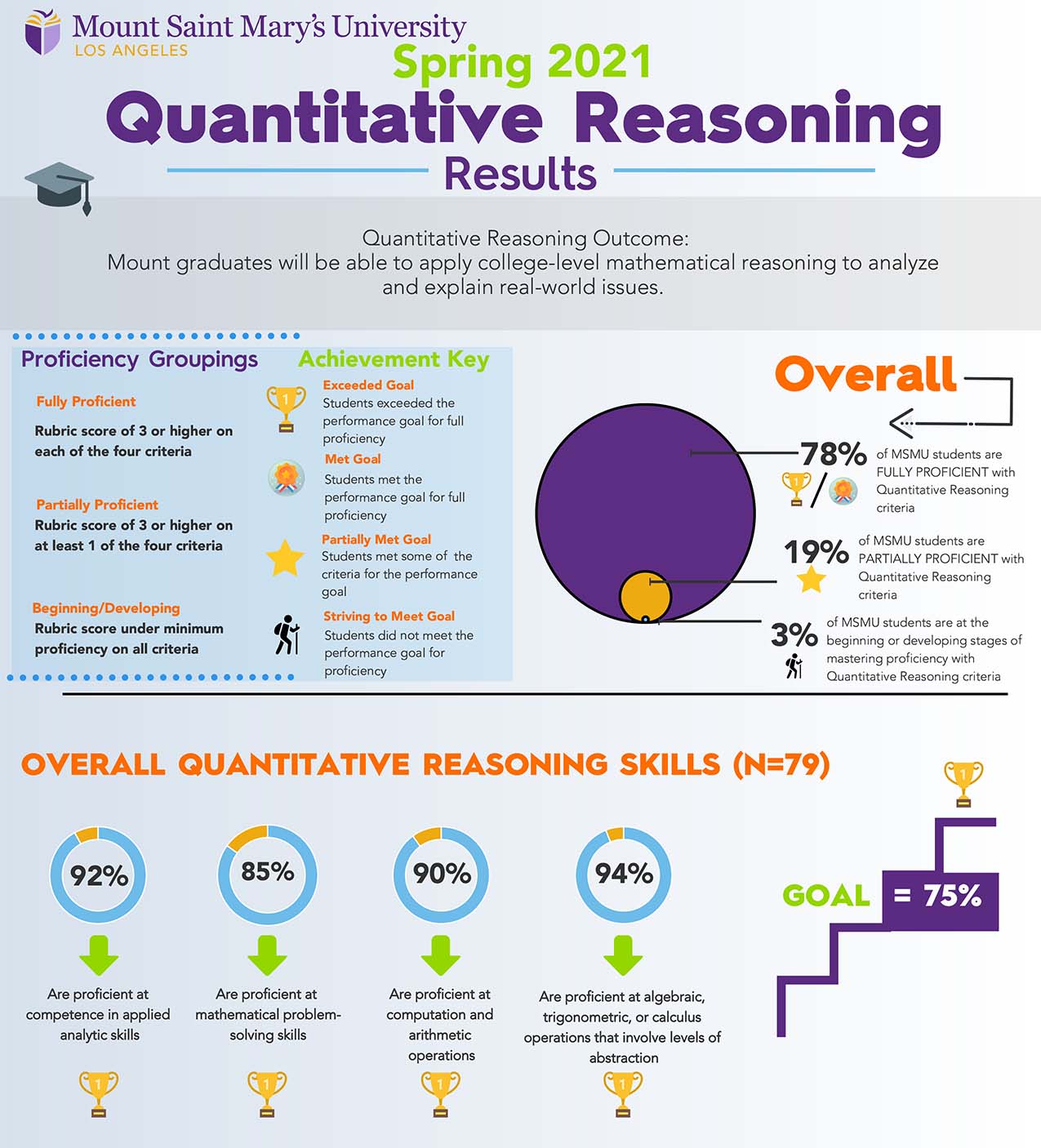
View Quantitative Reasoning Rubric (PDF) View Quantitative Reasoning Trend Data
Quantitative Reasoning Trend Data (2011-2017)
Identify Problem
Goal - 75%Determine Strategy
Goal - 75%Implement Strategy
Goal - 75%Reflection on Results
Goal - 75%Faculty discussed the following:
- Students performed best on understanding the problem
- Students struggled with reflection, although some assignments did not specifically ask students to reflect
- Results are consistent with faculty expectations
- The downward trend occurring may be related to the assignments not being as well aligned to the rubric as past years
- Consider having a common question for all assignments
- Encourage students to use resources provided in class for checking the reasonableness of results
- Have faculty model how to determine whether answers are reasonably correct
- Discuss with students the idea of the growth mindset by introducing meta-cognitive thinking exercises
Information Literacy (2019)
Snapshot Overview: To view the full Information Literacy Infographic, click the snapshot below.

View Information Literacy Rubric (PDF) View Information Literacy Trend Data
Define Project, Topic, and Questions
Goal - 75%Strategically Investigate Diverse Sources and Perspectives
Goal - 75%Evaluate Information and Its Sources Critically
Goal - 75%Incorporate Information Effectively and Ethically into New Work
Goal - 75%
Oral Communication (2022)
Oral Communication was last assessed in Spring 2022 and is next scheduled for Spring 2027. The rubric was last revised in 2021. Below are the results from Spring 2022 using the updated rubric.
The what
Arrangement of ideas
Vocal projection
Delivery
Pace
Non-Verbal communication
Eye contact
The main conclusions from this assessment are as follows (also see graph above):
- Students exceeded the goal for all seven criteria.
- It was surprising that students performed so well, but this made sense when considering that students were speaking to their peers and instructors which might have made them feel more comfortable.
- Students are increasingly comfortable with presenting themselves and their voices, which might be a by-product of the prevalence of social media.
The following actions were identified:
- Faculty can share assignment directions.
- Continue to provide multiple opportunities for students to speak and practice speaking for diverse audiences.
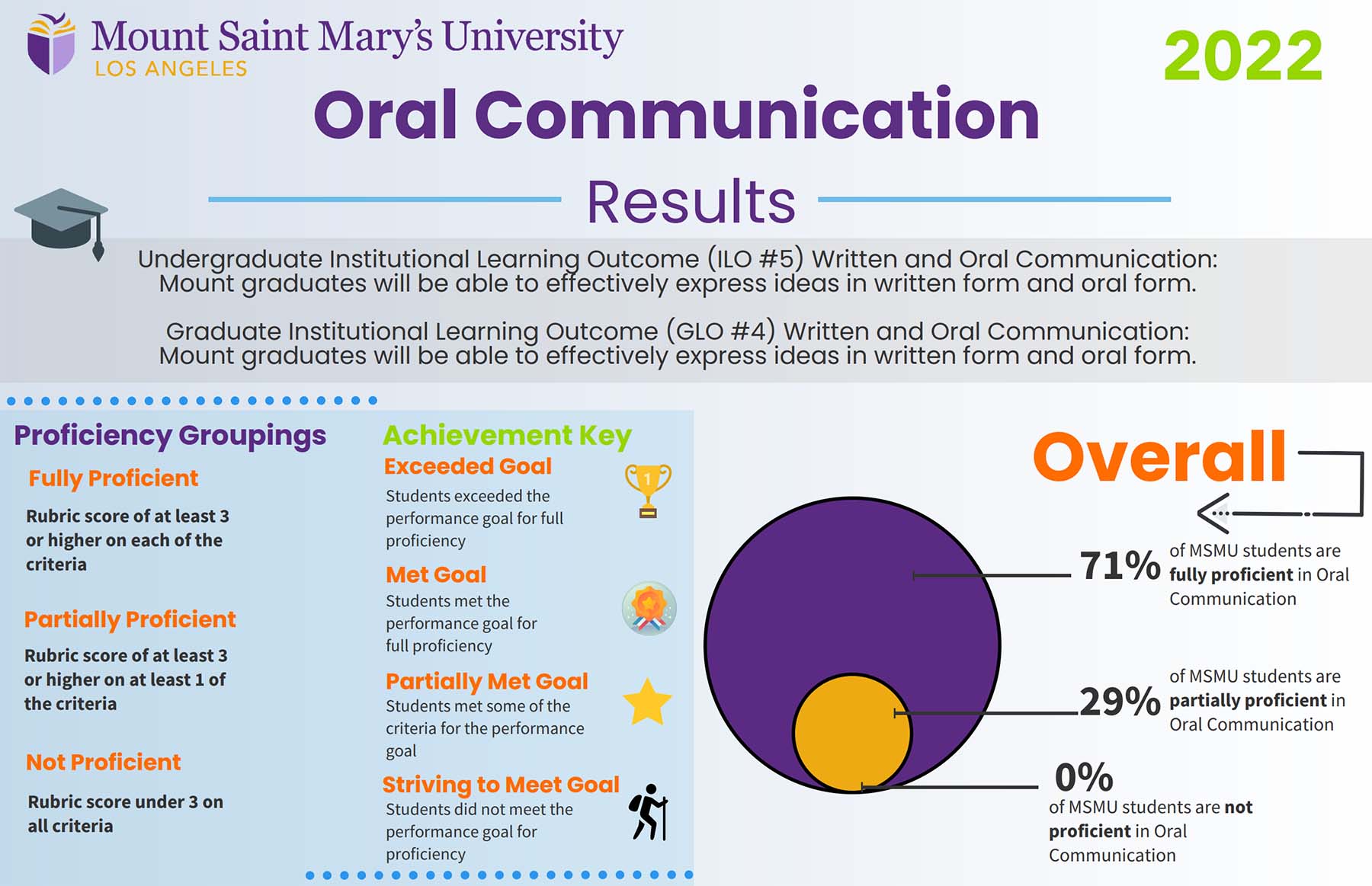
Snapshot Overview: To view the full Oral Communication Infographic, click the snapshot below.
Written Communication (2020)
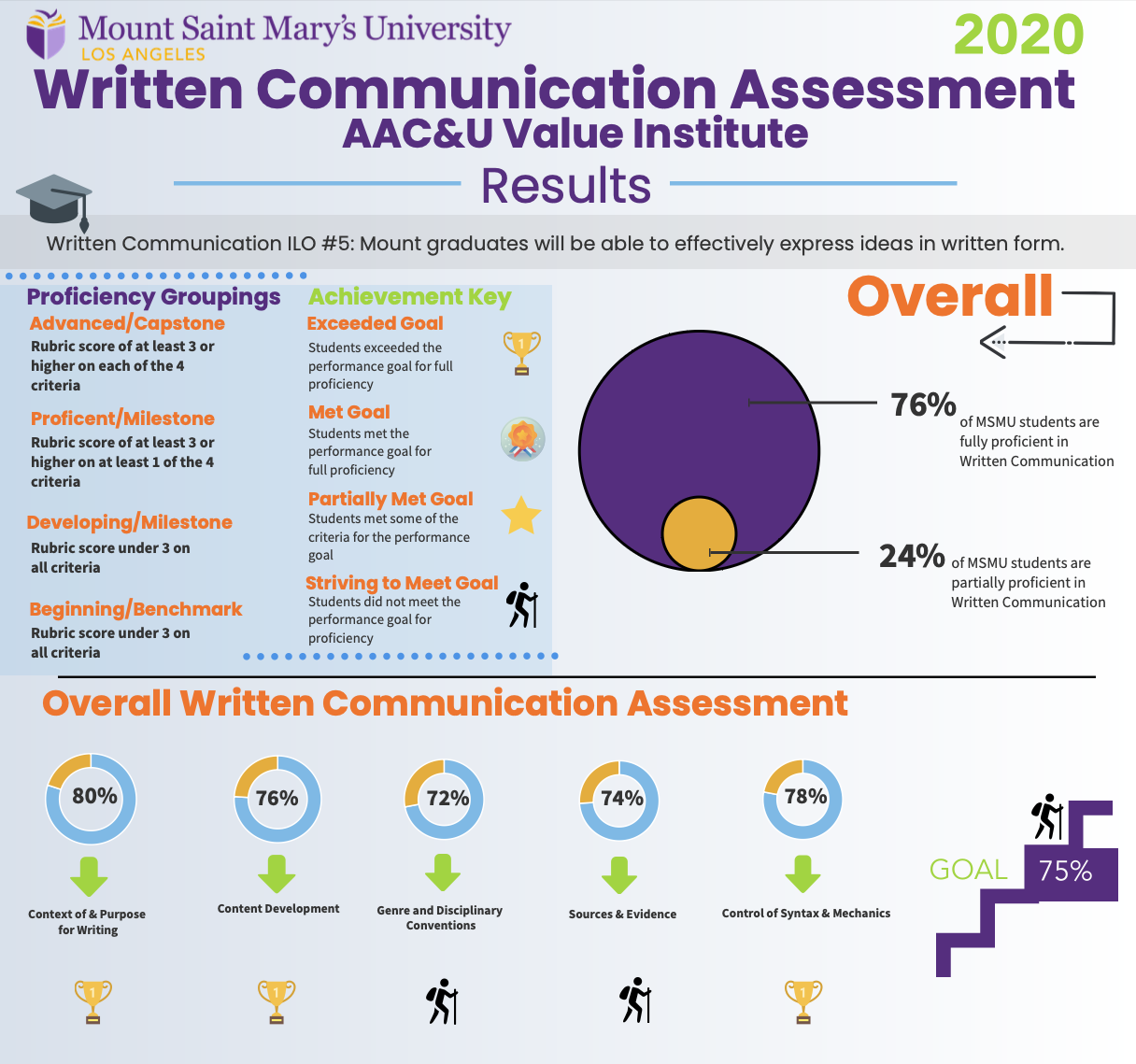
Snapshot Overview: To view the full Written Communication Infographic, click the snapshot below.
Content
Goal - 75%Organization
Goal - 75%Style
Goal - 75%Mechanics
Goal - 75%Faculty discussed the following:
- Students appear to be having difficulty with organization, style and mechanics
- Students need greater skills at editing and proofreading their work prior to submitting
- Students also struggle with formulating a clear central idea (thesis), which affects organization
- Since 2011, the overall results have improved
- Faculty should use more formal pieces of writing for this assessment (e.g. essays)
- Department should consider creating a separate, mandatory, college-level grammar class to be taken by all students prior to ENG 1A/B